The One Thing You Can Do Today to Start Your Company's Digital Transformation
Transformation stalls when five good ideas compete for the same Tuesday. Here is the one to start with, and the ten-minute check that shows if you need it.

TL;DR
Do one thing. Look up your company's domain on a WHOIS service and read the registrant field. If it names a former web designer, a reseller, or nobody anyone can name, every improvement you make from here sits on ground you do not own. The check takes ten minutes and costs nothing. The fix is a one-time job you never repeat.
Let AI summarise and analyse this post for you:
Start with the thing everything else sits on
Advice about digital transformation arrives as a list, and a list invites you to choose. Choosing is how a good idea becomes next quarter's problem. So here is the same advice with the choice taken out.
The Business Development Bank of Canada found 96% of Canadian small and mid-sized enterprises investing in digital technologies, and only the leading 8% rating as top performers on digital maturity. BDC puts the GDP gain from the rest catching up at $350 billion. Its own summary: the challenge is no longer awareness, it is execution.
I am less than a year from the thirtieth anniversary of the day I registered my first domain name. I still own it. That is what a one-time job looks like.
Execution is a sequence, and for almost every business I work with the first step is not software. It is a name on a record.
Owning it means being the name on the record
Every domain has a registrant: the party the registry recognises as its holder, and the only name that carries weight in a dispute. It is also routinely wrong. I find domains registered to the designer who built the site in 2018 and stopped answering email in 2021, or to an IT provider who registered it as a favour and now holds it as an asset.
Neither causes trouble until the first day you want to change something. Moving provider, proving to Microsoft that the domain is yours, recovering a registration nobody renewed: each stops dead at the same question, and the answer is either your company's name or a phone number nobody has.
What we did: we registered greyskytech.com ourselves, so the record carries our name. That is not paperwork, it is the hinge everything turns on. We can move the domain, prove ownership and change providers without asking anyone.
A free address cannot be repaired
If invoices go out from a free consumer email address, this is more urgent: you cannot fix the delivery problems you are about to have.
Business email is authenticated by three standards published as records on a domain: SPF, DKIM and DMARC. The Canadian Centre for Cyber Security's guidance is that complete protection requires all three, configured to instruct recipients to reject inauthentic messages. On a free address the domain belongs to the provider, so those records are not yours to repair, and you inherit the sending reputation of every other account on it.
The failure that costs the most is the quiet one. I have watched the same message reach one person and never arrive for their colleague, not even in a spam folder. Nothing bounced. You do not find out that you were filtered. You find out that you never heard back.
Your buyers are already checking
Customers run a cruder version of the same audit before you ever speak to them. CIRA, the not-for-profit that manages the .ca registry, polled 2,000 Canadian internet users for its 2026 report. It found 61% saying a website makes a business more credible, and 34% saying they do not trust an organisation without one.
That is a finding about websites rather than email addresses, and it is not worth stretching into one. The narrower point holds: your site and your email address are two faces of one owned presence, working for you before the first conversation.
If you are registering fresh, consider a .ca. CIRA publishes eighteen eligibility categories, a Canadian corporation among them, and validates the claim afterwards. That rule is the point: a .ca is a credential, not just an address.
What the fix actually costs
Less than the deliberation costs. Register the domain in the company's name, stand up a Microsoft 365 for Business tenant with multifactor authentication, move mail across, and you are done permanently.
Microsoft 365 Business Basic is C$9.50 per user per month on an annual subscription. Prices checked 16 August 2026, in Canadian dollars, before tax, and Microsoft revises them, so confirm before you budget. The domain itself is a few dollars a year, and my flat fee for the whole job starts at $400.
You do not need to be technical: I do the work and walk you through only the parts worth carrying in your head. If somebody else holds the domain, extracting it is part of the job. The record ends up in your company's name, and you own it whether or not you keep working with me. Beleaf Bookkeeping(opens in new tab) hold theirs today, and did not have to become technical to get there.
The ten-minute check
A WHOIS lookup is a free public search of the domain registry. Use one run by the registry itself rather than an ad-funded lookup site:
- CIRA WHOIS(opens in new tab), best for .ca domains, because CIRA runs the .ca registry
- ICANN Lookup(opens in new tab), the neutral choice for .com, .org and most other endings
- Verisign WHOIS(opens in new tab), authoritative for .com and .net
Enter your domain, the yourbusiness.ca part of your web and email addresses, and read three fields.
The registrant organisation should be your company's legal name. The administrative contact should be somebody who still works there. The expiry date should be far enough out that a missed renewal is not a live risk, and the renewal should sit on a company card rather than one that left with an employee.
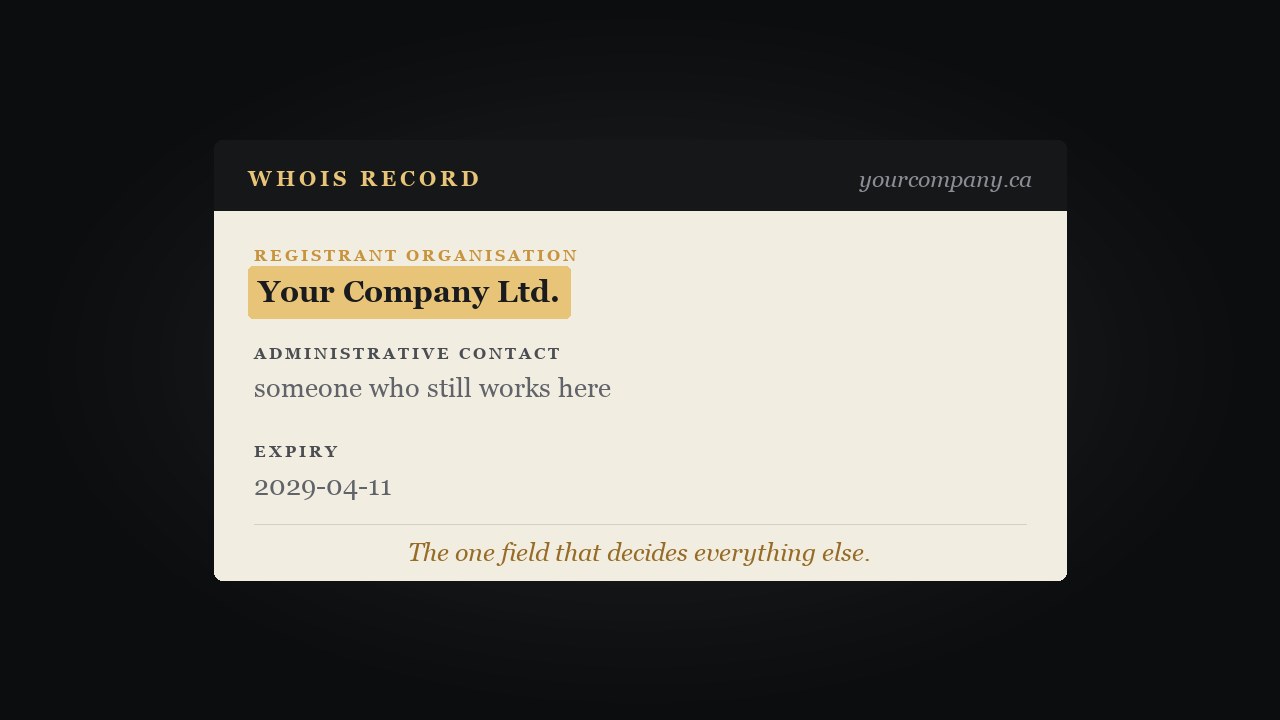
One quirk on a .ca: where the registrant is an individual rather than a corporation, CIRA withholds the contact details by design, so the record can look blank. Sign in to the registrar account instead. If nobody at the company can, you have your answer.
If your business has no domain at all, the check is over in ten seconds and the answer is the same: registering one in the company's name, with the mail moved onto it, is the first job.
If it is wrong, work out which registrar holds the domain and what proof of ownership you can produce, usually incorporation documents and a matching business address, before you open a ticket. Having those ready is the difference between an administrative task and a stalemate.
Where this starts
Small Fixes 2026 is five things a Canadian business can do this year, one a month. This is the first, and a piece at the end of the year ties them together.
If the free-address problem is the one you recognised, I have written up why "just use Gmail" stops working once a business gets serious and why I recommend Microsoft 365 to Canadian small businesses.
You do not need all five. You need the first one. Run the check, and if you are not sure what you found, send it to me and we will read it together.
Frequently Asked Questions
Establish that your company legally owns its domain name, then put your business email on it. Every other improvement depends on that one record: mail authentication, file storage, a Microsoft 365 for Business tenant you control, and later any AI tool worth using. The check itself costs nothing. Look up your domain on a WHOIS service and read the registrant organisation. If it names a former web designer, a marketing agency, an IT provider, or an individual who has left the company, you have found the first thing to fix. It is a one-time job rather than a project, and it is the only step on the list that everything else waits on.
Look the domain up on a public WHOIS service and read three fields: the registrant organisation, the administrative contact, and the expiry date. The registrant is the party the registry recognises as the holder, and it is the only name that carries weight when there is a dispute. For .ca domains registered to an individual rather than a corporation, CIRA hides the contact details on the public WHOIS by design, so the record may appear blank. That is still an answer. Sign in to the registrar account directly instead, and if nobody at the company can, that inability is precisely the problem worth fixing.
Because the three standards that authenticate business email, SPF, DKIM and DMARC, are records published on a domain. On a free consumer address the domain belongs to the provider, not to you, so those records are not yours to publish or repair. The Canadian Centre for Cyber Security's implementation guidance states that complete protection requires all three protocols, configured to instruct recipients to reject inauthentic messages. You also inherit the sending reputation of every other account on that service. The failure mode is silent: a filtered message does not bounce, so you never learn it was not delivered.
Yes, provided it meets CIRA's Canadian Presence Requirements. CIRA, the not-for-profit that manages the .ca registry, publishes eighteen categories of eligible registrant, and a corporation incorporated under the laws of Canada or of a province or territory is one of them. Registrants select a category when they register and CIRA may afterwards ask for proof through a process it calls Registrant Information Validation. The requirement is a feature rather than an obstacle: it is the reason a .ca signals a real Canadian connection instead of merely claiming one.
Related Service
Deployment, training, and ongoing support to make your AI investments pay off.
Learn about Adoption and Training