Ottawa Crafted a World-Class AI Strategy. Main Street Is Still Waiting.
Canada's AI for All is an excellent strategy with one gap: direct adoption dollars for small business. A leaner, CDAP-style fix and local AI pros.

TL;DR
After two years helping British Columbia's small businesses actually adopt AI, I read all of Ottawa's new National AI Strategy looking for them, and they are barely in the mechanisms. AI for All builds the top of the pyramid brilliantly: the compute, the champions, the research. But adoption happens on the ground, one owner at a time, and there is no funded, hands-on channel to get it there. We solved this once with the Canada Digital Adoption Program and its local advisors; a leaner, tighter successor called the Canada Artificial Intelligence Adoption Program, or CAIAP, would finish the job, and the still-unfinished $500 million Regional AI Initiative is the place to build it.
Let AI summarise and analyse this post for you:
Canada's AI for All is a strong, serious strategy
Let me say this clearly, because I mean it: AI for All is a strong, serious strategy, and Canada should be proud of it.
Launched on June 4, 2026 by Prime Minister Mark Carney and AI Minister Evan Solomon after a national consultation, it backs Canada's AI legacy, the work of Geoffrey Hinton, Yoshua Bengio, and Richard Sutton, with real infrastructure . It funds a world-leading public supercomputer, sovereign compute and data centres, and grows the Canada CIFAR AI Chairs from 130 to nearly 200 researchers . It launches a new AI Missions Program, beginning with $200 million for a first mission in health care, and invests another $100 million in a Health Sector Data Space and $100 million to expand the VITAL health data platform . It launched a Sovereign Technology Alliance with Germany, and it backs LawZero, Yoshua Bengio's nonprofit AI-safety lab in Montreal .
This is serious, well-built policy. There is almost nothing in it I would cut. There is one thing I would add, and it is what the rest of this piece is about.
Where a strong strategy is thinnest: getting AI to Main Street
The strategy is candid about the job ahead. Only 12 percent of Canadian businesses use AI today, and it sets a target of 60 percent by 2034 . That is a 48-point climb, and it rests on the smallest businesses, the ones that make up the bulk of the economy.
Micro, small, and medium enterprises are 99 percent of Canadian businesses and employ 14.3 million people . Yet when the document pictures "a Canadian business," it tends to see a tech startup, a mid-size manufacturer in a priority sector, or a worker who needs reskilling. The owner-operator running a profitable shop, not trying to become a tech company, just wanting AI to save a few hours and serve customers better, is in every target and in almost none of the mechanisms.
You can even see it in the language. Across 47 pages of content, "SME" appears 23 times, "sovereign" 51, and "invest" 55. "Small business" appears once. "Grant" and "advisor" appear zero times, and so do "restaurant," "retail," and "Main Street." I went looking for the family restaurant, the dry cleaner, the florist, the corner hardware store, the bookkeeper, the auto shop, the hair salon, and the local pet store. None of them are in the document. That is not a knock on the drafters. It is a sign of where the strategy's centre of gravity sits, and it sits at the top.
Follow the money: where the dollars go, and the one place they don't
Add up the big named dollars and you clear $2 billion before you reach Main Street. They are going to important places: a $500 million Canadian Tech Growth Fund, a $700 million expansion of the Compute Access Fund for SMEs building AI, a $500 million Regional Artificial Intelligence Initiative, $500 million in LIFT financing through the Business Development Bank of Canada (BDC), $130 million for commercialisation, and $1.75 billion from Budget 2025 for venture capital . None of that is wasted, and Canada is right to fund it.
The closest line to the corner store is $30 million for CanCode, which funds nonprofits to teach digital skills to students from kindergarten to grade 12 . Worthwhile, but it reaches kids in classrooms, not owners behind the counter.
What is not in the budget is a direct adoption dollar for an existing small business, or a funded network of people to help them use AI. The closest candidate, the $500 million Regional AI Initiative, is still being designed, with no per-business amount, eligibility, or timeline yet . An unfinished program is also an opportunity.
Adoption happens on the ground, one business at a time
AI for All is strongest on the supply side: the compute, the champions, the research, the safety. That is the right foundation, and Canada needs every piece of it. Adoption is a different kind of problem, and it is the one I work in every day.
I have spent the last two years helping small businesses in British Columbia actually adopt these tools, and here is what the work has taught me: adoption happens on the ground. The supercomputer never touches the corner store. A scale-up's funding round does nothing for the florist. Owners do not start using AI because Ottawa funded a frontier lab in Toronto. They start when someone sits down with them, finds the two or three tasks AI can take off their plate, and helps them put it to work. Then the shop on the next block sees it and asks how.
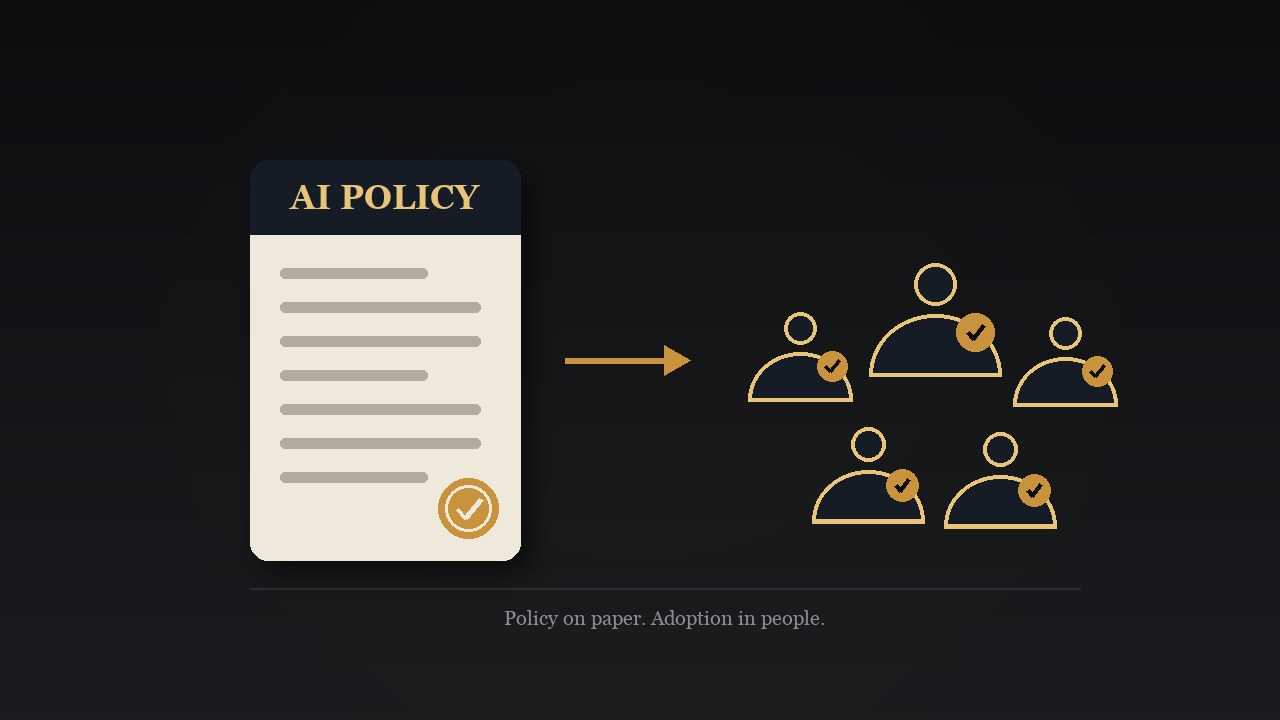
Building the capability at the top is necessary, and it is not the same as adoption. A great supply-side strategy creates the tools. Adoption takes a dollar and a person on the ground beside the owner. AI for All does the first part brilliantly. The second part is the piece still to add, and it is what would carry the 12 percent to 60 percent target home .
What AI for All offers the corner store today
To be fair and specific, here is what an owner-operated small business outside the priority sectors can reach right now.
Free AI literacy training through public libraries and community organisations : useful for understanding what AI is, but it does not fund tools or give time back. An online AI Literacy and Adoption Assessment tool : a free self-assessment that points you in a direction and stops there. The modernised Job Bank, with $50 million for AI-powered matching : handy if you are hiring, not an adoption program. The SR&ED tax credit and the new Productivity Super-Deduction : real value if you are spending on qualifying research and have the tax appetite, which most small shops do not. And the Small Business and Entrepreneurship Development Program, named once, with no dollar figure attached .
It is a genuine toolkit, and every piece has a use. What it does not yet include is the piece that actually drives adoption: a funded advisor at the owner's side.
A workshop is a great start, not the whole job
The strategy diagnoses the barrier well. It reports that 78 percent of non-adopting firms do not see how AI benefits their goods or services, and calls it a "translation problem" . The response is to train people, largely through libraries and community groups.
For a busy owner, though, the barrier is rarely a missing lecture. It is no time to experiment, no budget for a tool that might not fit, no trusted local advisor who knows their trade and their scale, no peers who have done it, and no low-risk way to try before spending real money. A workshop helps with awareness. It does not clear those.
It is also a lot to ask of the partners. Libraries are trusted and capable, and a sensible front door, but the strategy leans on them, and on rural, remote, and northern community organisations, for a significant new role, often in the regions with the tightest budgets . Canada ranked 44th of 47 countries on AI training and literacy in the global study the strategy cites , a survey of more than 48,000 people across 47 countries . A gap that size deserves dedicated funding behind those willing partners, not just goodwill.
Canada already built the right model once: CDAP's digital advisor network
Here is the encouraging part: Canada has done this before, and it worked.
The Canada Digital Adoption Program had two streams, both built around a person. Grow Your Business Online offered a micro-grant of up to $2,400, open to businesses with as little as $30,000 in revenue or a single employee , the program that actually reached the dry cleaner and the florist. Boost Your Business Technology offered up to $15,000 to build a Digital Adoption Plan, with 90 percent of the cost covered, followed by up to $100,000 in interest-free BDC financing to implement it .
The detail that mattered most was the advisor. A real person, often working through a chamber of commerce, sat down with the owner, understood the business, made a specific recommendation, and the funding paid to put it in place. It was high touch, it respected the owner's time, and it was bottom-up by design. Then Boost Your Business Technology closed to new applicants in February 2024, fully subscribed, less than three years into a four-year program . By then it had reached more than 53,000 small and medium businesses and disbursed over $229 million .
CDAP was not perfect. It was generous, it was popular, and it ran out of room early. A successor can learn from exactly that: smaller cheques, tighter eligibility, and clearer controls, so the model that worked can run sustainably this time.
Main Street doesn't need another pamphlet. It needs a local AI professional.
Full disclosure: I am one of those local AI professionals. I help small businesses in British Columbia adopt these tools for a living, which is exactly why I am confident a pamphlet and a self-assessment quiz are not what gets a small business started.
What works is someone local who will sit at the counter, look at how the business really runs, and say: here are the three use cases that will save you the most time, here is the workflow, here is the tool, and here is how we will know it worked. That is the translation the strategy rightly says is missing, done by a person.
Every barrier I listed is answered this way. Time: the advisor does the legwork. Budget: a small payment de-risks the first step. Trust: the advisor is local and accountable. Peer proof: a good advisor carries what worked for the shop down the street. Low-risk trial: the plan is scoped before anyone spends real money. CDAP proved this works at national scale. The technology changed; the need did not.
Put the adoption dollars in local hands
This is the piece I most hope Ottawa builds, and I believe it can.
Today, the strategy's support for small business runs through BDC financing, the Regional Development Agencies, and tax measures like SR&ED . Those are sound instruments, but a small shop with no in-house finance or IT is the least equipped to find and apply for them, so the help tends to reach the businesses that already have help. A dedicated channel that pays local AI professionals to do the hands-on work, the way CDAP paid advisors, puts the support where it is needed.
Picture a Canada Artificial Intelligence Adoption Program, or CAIAP: a direct adoption payment in the range of $3,000 to $5,000 per business, deliberately smaller and more tightly run than CDAP, with clear eligibility for the smallest firms, a verified outcome attached to each payment, and a budget that holds. It would fund a certified network of local AI advisors with AI-specific skills. Ottawa already knows how to certify and pay a national advisor network, because it did exactly that three years ago.
And there is an obvious place to start. The $500 million Regional AI Initiative is still being designed, its eligibility and delivery yet to be set . It could be shaped into precisely this kind of on-the-ground adoption channel. That would turn the one gap into one of the strategy's strongest features, and I would be glad to help build it.
AI for All, and the one piece that would complete it
AI for All is a strong strategy with a genuinely impressive top end: sovereign compute, the health data platform, the alliance with Germany, support for frontier and safe-by-design AI. Canada needs all of it, and I am glad it is here.
The one piece that would make the name true is a direct, on-the-ground way to help the smallest businesses adopt: the dry cleaner, the florist, the family restaurant, the corner hardware store, the bookkeeper, the auto shop. It is not complicated and it is not new. We proved the model with CDAP, and a leaner, tighter successor would finish the job. The room to add it already exists.
If you run a small business in British Columbia and you would rather have a person than a pamphlet, that is what we do. Get in touch and we will find the AI use cases that earn their keep in your business.
Frequently Asked Questions
No. AI for All, released in June 2026, contains no direct grant for an existing small business that wants to adopt AI tools. What it offers Main Street is mostly indirect: free AI literacy training through public libraries, an online self-assessment tool, the modernised Job Bank, the SR&ED tax credit and the new Productivity Super-Deduction, and LIFT financing through the Business Development Bank of Canada, which is a loan you have to qualify for rather than a grant. The one program with 'small business' in its name is mentioned once, with no dollar figure attached. The word 'grant' does not appear anywhere in the strategy's 47 pages of content.
Not a direct one. The Canada Digital Adoption Program, which paid a local digital advisor to help a small business adopt technology, closed to new applicants in February 2024. The closest thing in AI for All is the $500 million Regional Artificial Intelligence Initiative delivered through the Regional Development Agencies, but it has no published per-business amount, no eligibility criteria, and no delivery timeline, and it is meant to cover both adoption and commercialisation across the whole country at once. Because it is still being designed, there is room to shape it into a direct small-business adoption channel.
Start with the work, not the tools. The most reliable path is to find the two or three tasks that eat the most time in your business and apply AI there first, rather than trying to adopt AI in the abstract. A short, practical engagement with someone who understands both the tools and your kind of business will usually surface those use cases faster than any amount of reading. For most owners the barrier is not a missing lecture, it is time, budget, and trust, so pick one low-risk workflow, prove it works, and build from there.
A good local AI advisor sits down with the owner, looks at how the business actually runs, and identifies the specific use cases and workflows where AI will save the most time or money. They recommend the right tool for your scale, help you set it up, and define how you will know it worked. It is the model CDAP used for digital adoption: a trusted person doing the translation from 'AI exists' to 'here is what it does for your shop,' instead of handing you a pamphlet or a self-assessment quiz and wishing you luck.
That is what Grey Sky Tech does. We work with small businesses and nonprofits across British Columbia to find the AI use cases that earn their keep, set up the tools and workflows, and train your team to use them. You do not need to become a tech company or wait for a federal program to begin. If you would rather have a person than a pamphlet, get in touch with us through the contact page on greyskytech.com.
Related Service
Strategic AI advisory and custom solutions built for your industry.
Learn about Artificial Intelligence