How to Build an AI Adoption Plan That Your Team Will Actually Follow
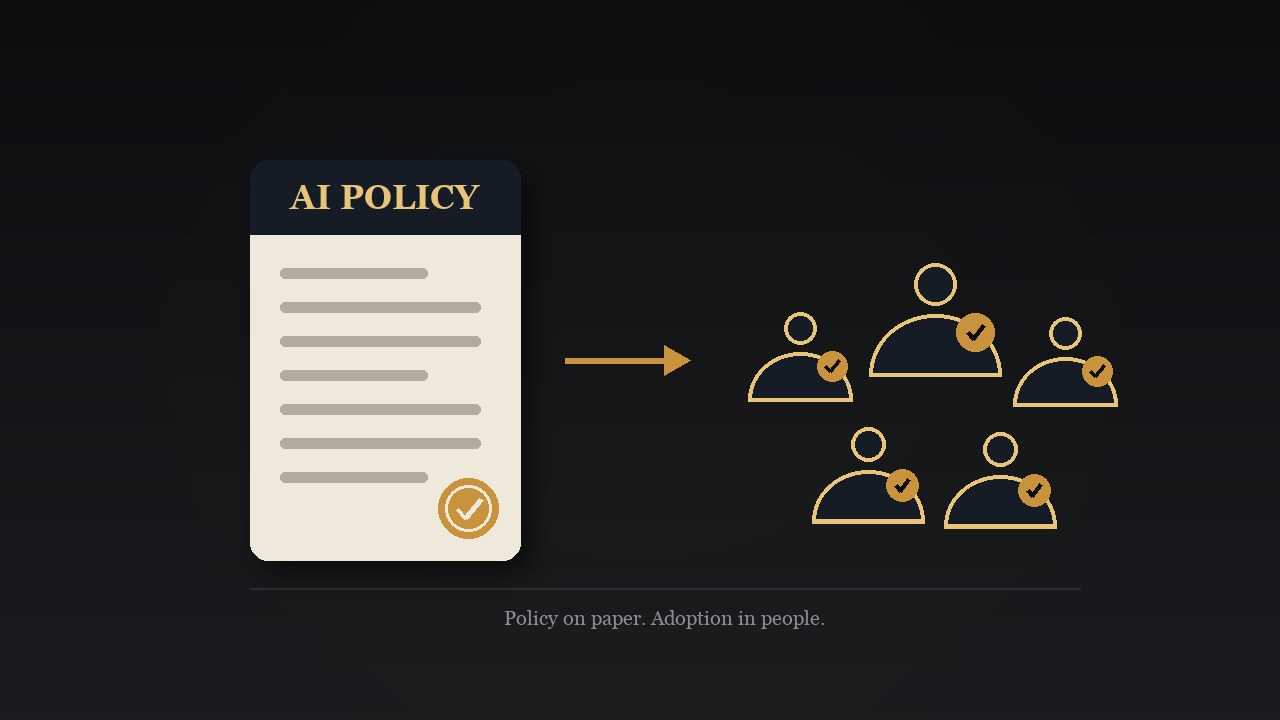
Most AI initiatives fail because of people, not technology. Here's how to create an adoption plan that gets your team on board and keeps them there.

TL;DR
Between 70% and 85% of AI projects fail to deliver expected value, and the problem is almost never the technology. It's people. A successful adoption plan starts with personal "what's in it for me" motivation, identifies internal champions, rolls out in small focused waves, trains for confidence (not just competence), and measures adoption rather than deployment. Build learning into your culture and AI becomes a permanent advantage.
Let AI summarise and analyse this post for you:
The technology isn't the hard part
Here's a stat that should give every business leader pause: according to research from RAND Corporation, more than 80% of AI projects fail to deliver their expected value, a failure rate double that of non-AI IT projects. A 2024 global survey by NTT DATA found a similar pattern, with 70% to 85% of generative AI deployments failing to meet ROI expectations.
The technology works fine. The problem is almost always adoption.
People resist change. They worry about job security. They don't trust tools they don't understand. They revert to old habits when the new way feels harder. None of these are technology problems. They're people problems.
And they're solvable, if you plan for them from the start.
Step 1: Start with the "why" that matters to your team
"Increase efficiency" and "drive innovation" are company goals. They're not motivating to the person who's being asked to learn a new tool on top of their existing workload.
Your adoption plan needs to answer the question every employee is actually asking: "What's in it for me?"
Maybe AI will eliminate the mind-numbing data entry they hate. Maybe automation will mean they stop working overtime every month-end. Maybe a chatbot will handle the repetitive customer questions so they can focus on complex, interesting problems.
Find the personal benefit. Lead with it.
Step 2: Pick your champions
Every team has people who are naturally curious about technology. They're the ones already experimenting with ChatGPT on their own time. They try new apps before anyone asks them to.
These are your adoption champions. Get them involved early, give them access to the tools first, let them become the internal experts. When their peers see a colleague succeeding with the new tools, adoption spreads organically.
Research from Prosci, drawing on more than 25 years of change management data, shows that projects with excellent change management are seven times more likely to meet their objectives than those with poor change management. Champions are your front-line sponsors, and sponsorship is one of the biggest contributors to that change management success.
Step 3: Start smaller than you think you should
The biggest mistake we see is trying to roll out AI across the entire organisation at once. It overwhelms people and creates chaos.
Pick one team, one process, one tool. Get it working. Demonstrate the results. Then expand.
A successful small win does more for adoption than the most compelling company-wide presentation ever could.
Step 4: Train for confidence, not just competence
There's a difference between knowing how to use a tool and feeling confident using it. Most training programmes aim for competence: "Here's how the tool works." That's necessary but insufficient.
Confident users experiment. They find new use cases you didn't plan for. They become advocates. Competent-but-uncertain users stick to the bare minimum and quietly revert to old methods when nobody's watching.
McKinsey research found that 87% of executives and managers say they face or expect skill gaps in their workforce. Yet closing those gaps takes more than a single training session. It takes ongoing support, practice, and a culture that makes learning safe.
Build confidence through:
- Hands-on practice with real work scenarios, not generic exercises
- Safe spaces to fail where mistakes are learning opportunities
- Ongoing support so people know help is always available
- Celebrating wins publicly when someone uses the tools effectively
Step 5: Measure what matters
Track adoption metrics, not just implementation metrics. It's not enough to know that the tool is deployed. You need to know if people are actually using it, and whether it's delivering the results you expected.
Useful metrics include:
- Active usage rates (daily/weekly)
- Time saved per process
- Error rates before and after
- Employee satisfaction with the tools
- Number of new use cases discovered by the team
Step 6: Build a culture of continuous improvement
AI adoption isn't a project with a start and end date. It's an ongoing practice. New tools emerge constantly. Your business processes evolve. Your team's skills grow.
McKinsey found that since the pandemic, digital skills have become a top priority, with a 16-percentage-point increase in organisations identifying them as critical. The organisations that get the most value from AI are the ones that build learning and improvement into their culture. Regular check-ins, knowledge sharing sessions, and a willingness to experiment are what separate businesses that "tried AI" from businesses that are powered by it.
Getting it right
AI adoption planning isn't something you should figure out on your own. It requires expertise in change management, training design, and technology implementation, along with a deep understanding of your specific business.
At Grey Sky Tech, adoption isn't an afterthought. It's one of our three core pillars, and it's baked into every engagement from day one. Reach out to learn how we can help your team embrace AI and automation with confidence.
Frequently Asked Questions
Rarely because of the technology, and almost always because of adoption. RAND Corporation found more than 80 percent of AI projects fail to deliver their expected value, double the failure rate of non-AI IT projects, and a 2024 NTT DATA survey found 70 to 85 percent of generative AI deployments miss their ROI expectations. People resist change, worry about job security, distrust tools they do not understand, and revert to old habits when the new way feels harder. Those are people problems, and they are solvable if you plan for them from the start.
Lead with the personal benefit. Company goals like 'increase efficiency' do not motivate someone being asked to learn a new tool on top of their workload, so answer the question they are really asking: what is in it for me? From there, identify the natural champions who already experiment with technology, roll out in small focused waves, train for confidence rather than bare competence, and measure whether people are actually using the tool. Adoption spreads when peers see a colleague succeeding with it.
Competence is knowing how a tool works; confidence is feeling able to use it without hesitation. Most training stops at competence, which is necessary but insufficient. Confident users experiment, find new use cases, and become advocates, while competent-but-uncertain users do the bare minimum and quietly revert to old methods. You build confidence through hands-on practice with real work, safe spaces to fail, ongoing support, and celebrating wins publicly.
Track adoption, not just deployment. Knowing a tool is installed tells you nothing about whether it is used. Useful metrics include active usage rates (daily or weekly), time saved per process, error rates before and after, employee satisfaction with the tools, and the number of new use cases your team discovers. Those tell you whether the tool is delivering the results you expected.
No. The most common mistake is trying to deploy AI everywhere at once, which overwhelms people and creates chaos. Start smaller than you think you should: one team, one process, one tool. Get it working, demonstrate the results, then expand. A single successful small win does more for adoption than the most polished company-wide presentation. At Grey Sky Tech, adoption is one of our three core pillars and is built into every engagement from day one.
Related Service
Deployment, training, and ongoing support to make your AI investments pay off.
Learn about Adoption and Training