Monday, September 7, 2026
All day
Presented by Government of Canada
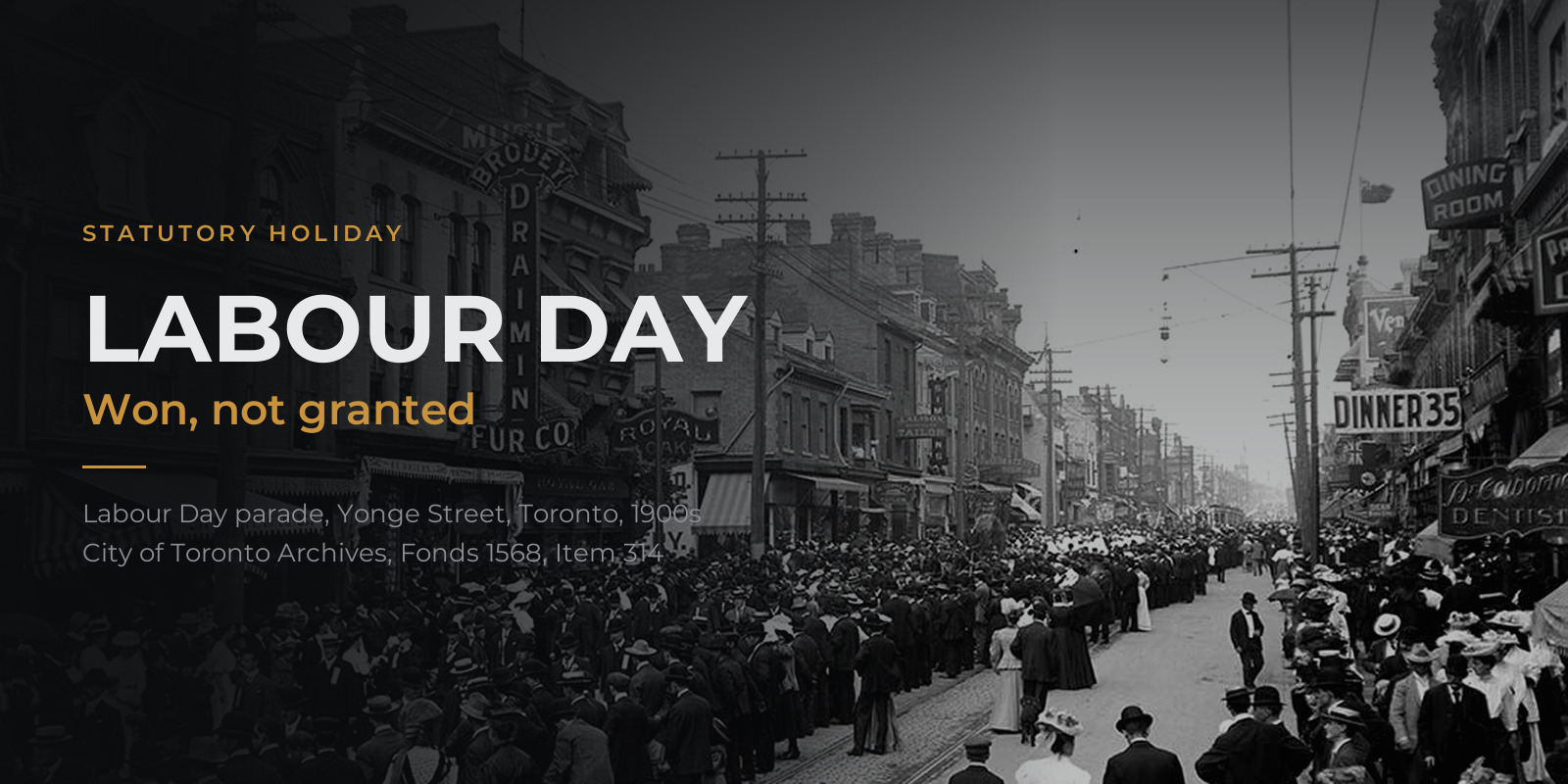
Labour Day was not handed over out of goodwill, and the fight behind it was not about a holiday. Toronto's printers struck for shorter hours in March 1872. On Monday 15 April the city's trades marched to Queen's Park in support of them, over 10,000 present by the count of the Ontario Workman, the labour paper the printers had just founded. The next morning the master printers swore out twenty-four warrants for the union's whole vigilance committee, charged with conspiring to lessen the usual hours of work. Fourteen were committed for trial, but once Parliament passed a Trade Unions Act the attorney general dropped the prosecution, so the claim that organising was itself a crime was never tested in court. Three weeks after the arrests Sir John A. Macdonald moved two bills together: one declaring a union's purposes not unlawful merely because they restrained trade, the other making it an offence to watch or beset anyone to coerce them, which is to say to picket. Both were assented to on 14 June 1872. The parades came later. Library and Archives Canada dates a Toronto labour parade to July 1882, weeks before New York held its first that September. By 1889 the Royal Commission on the Relations of Labor and Capital in Canada reported that several Canadian towns already proclaimed a yearly holiday in honour of labour, and recommended one be set apart across the Dominion. It was the skilled trades' day, and by The Canadian Encyclopedia's account the women who organised and fed it rarely marched in it, while unskilled and immigrant workers were largely outside the unions that ran it. Prime Minister Sir John Thompson introduced the holidays bill on 7 May 1894, and asked in June whether working men had applied for it, he answered that hundreds of petitions had come from all quarters. Royal assent followed on 23 July. Sources: the Ontario Workman (1872), the 1889 Royal Commission report, House of Commons Debates, the Statutes of Canada, and The Canadian Encyclopedia.
Anu's Take
My grandfather, Edward Bigelow Jolliffe, was called to the Ontario bar in 1936 and spent most of the next half-century in labour law, first on the union side as Canadian general counsel to the Steelworkers, then from 1969 as chief adjudicator under the federal Public Service Staff Relations Act, ruling on other people's grievances about collective agreements, discipline and dismissal. In between he led the Ontario CCF for eleven years and was twice leader of the Opposition, three of those years without a seat of his own. He was still hearing grievances for an Ontario board at seventy-nine, and he died peacefully on Salt Spring Island, a ferry ride from where I am writing this. I doubt he thought of the first Monday in September as just a long weekend.
Want my next pick in your inbox? Get event alerts.
Published Friday, August 7, 2026 by Anu Jolliffe on LinkedIn