Queue Smart: Giving ER Patients Their Time Back
How we built Queue Smart, an ER patient communication platform that shows queue position, estimates wait times, and lets patients leave while keeping their spot
TL;DR
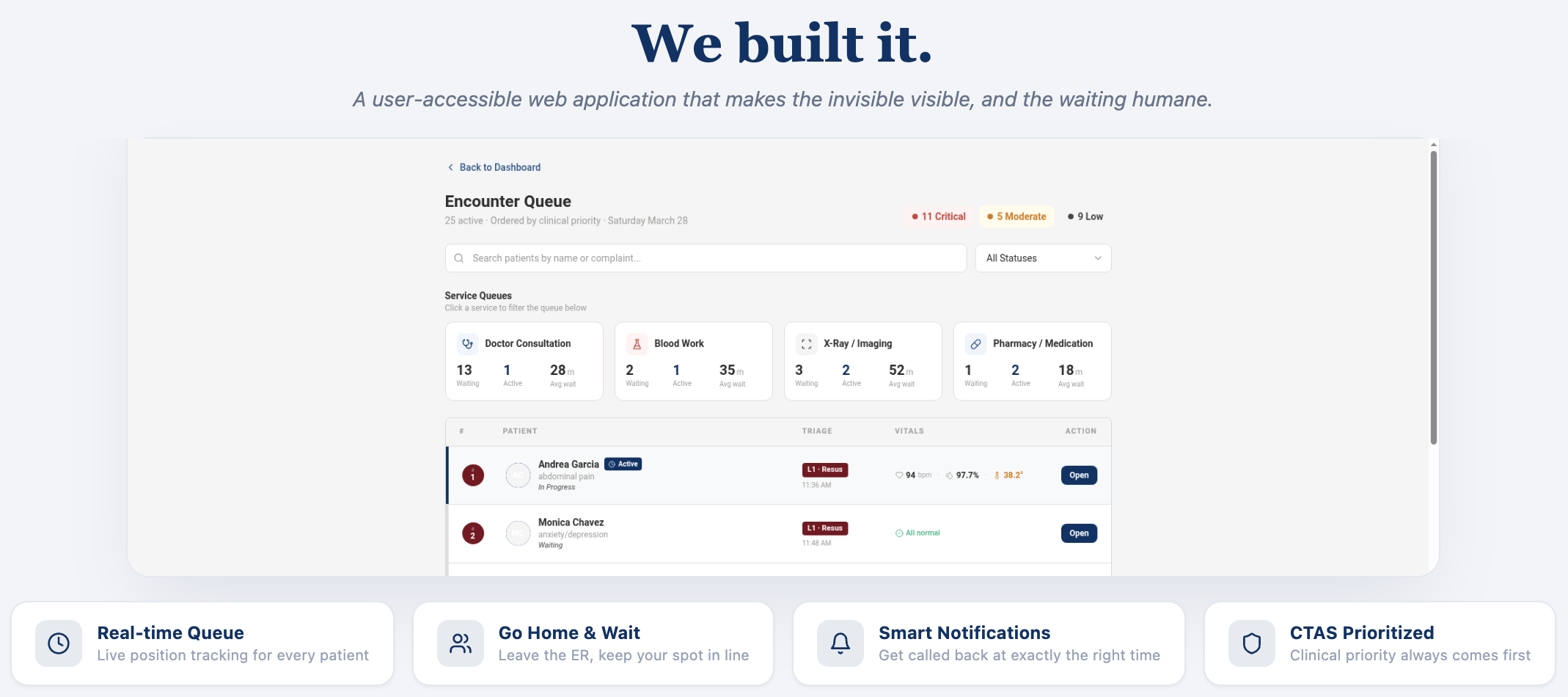
Queue Smart is an emergency room patient communication platform built on Microsoft Power Platform during a healthcare hackathon. It solves a specific problem: patients sitting in crowded ERs for hours with no idea when they will be seen. Queue Smart shows patients their real-time queue position, provides wait time estimates, and lets them leave the hospital while keeping their spot in line. For clinicians, it provides a live queue view with patient context, triage levels, and the ability to adjust priority as conditions change on the ground.
Let AI summarise and analyse this post for you:
The Waiting Room Nobody Chooses
Imagine you live in Victoria, British Columbia. You wake up with something that is not an emergency, but it is not nothing either. It has been nagging you for weeks. You do not have a family doctor. Across Canada, more than six million adults lack access to a regular family doctor or nurse practitioner . The walk-in clinics are full by the time you check. So you make the choice you have been avoiding. You go to the emergency room.
You already know what this means. You will be triaged quickly. Then you will wait. Four hours if you are lucky. Eight if you are not. With more than 16.1 million unscheduled emergency department visits reported across Canada in a single year , the system is under constant pressure. You sit in a crowded room with people who are very sick, people who are bored, people who are anxious. You scroll. You pace. You wonder if you should have just waited another week.
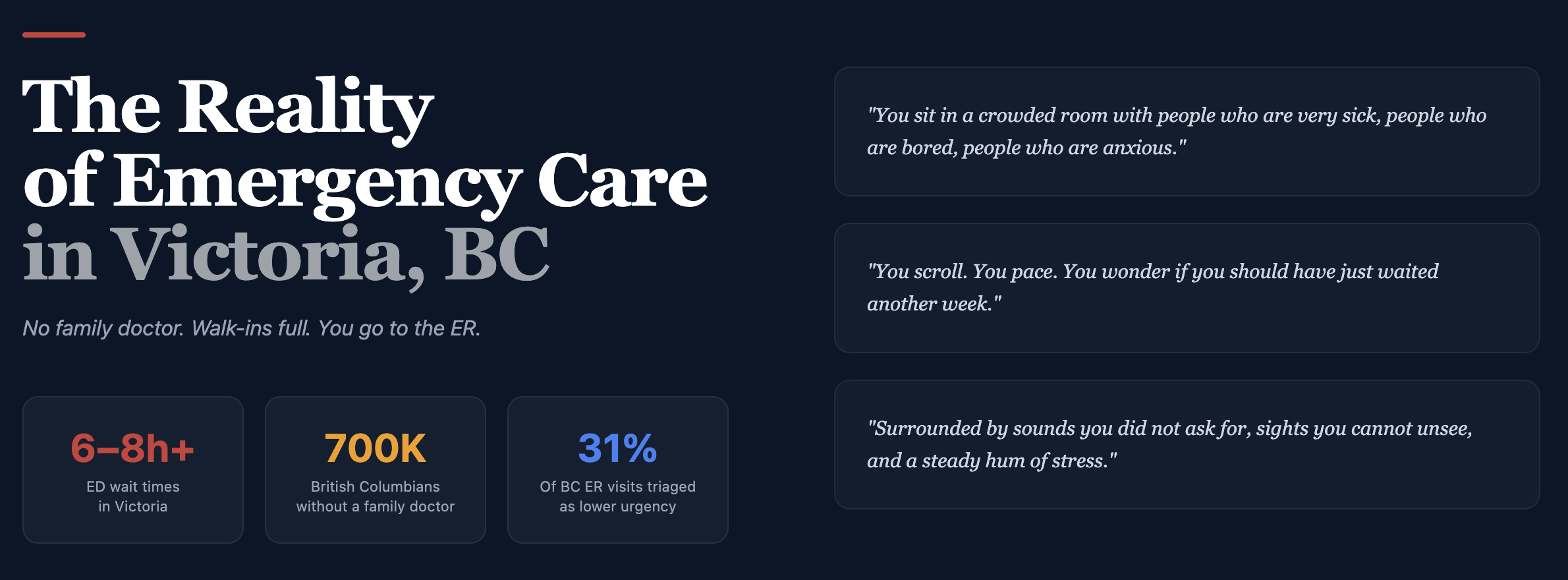
And you are not alone in that calculation. Rates of patients leaving Canadian emergency departments without being seen have been climbing steadily. In Ontario, monthly departure rates exceeded the pre-pandemic peak of 4% during 75% of months in 2022-2023 . These are not people who got better. They are people who gave up. And the consequences are real: patients who leave without being seen face a 14% higher risk of death or hospitalisation within seven days .
A Different Kind of Emergency Room Visit
Now imagine a slightly different world. You go to the same emergency room for the same minor issue. You are triaged just as quickly. But this time, you are offered a choice. You can opt in to a communication platform on your phone. You see your place in the queue. You see how many people are ahead of you. You see a realistic estimate of when you will be seen. No guessing. No hovering. No wondering if you missed your name.
Now imagine we take it one step further. You are told that you can leave. You can go home. You can sit on your own couch. You can make dinner. The system keeps your place in line. It updates in real time. When it is time to come back, you get a notification telling you exactly when to leave so you arrive on time and keep your spot.
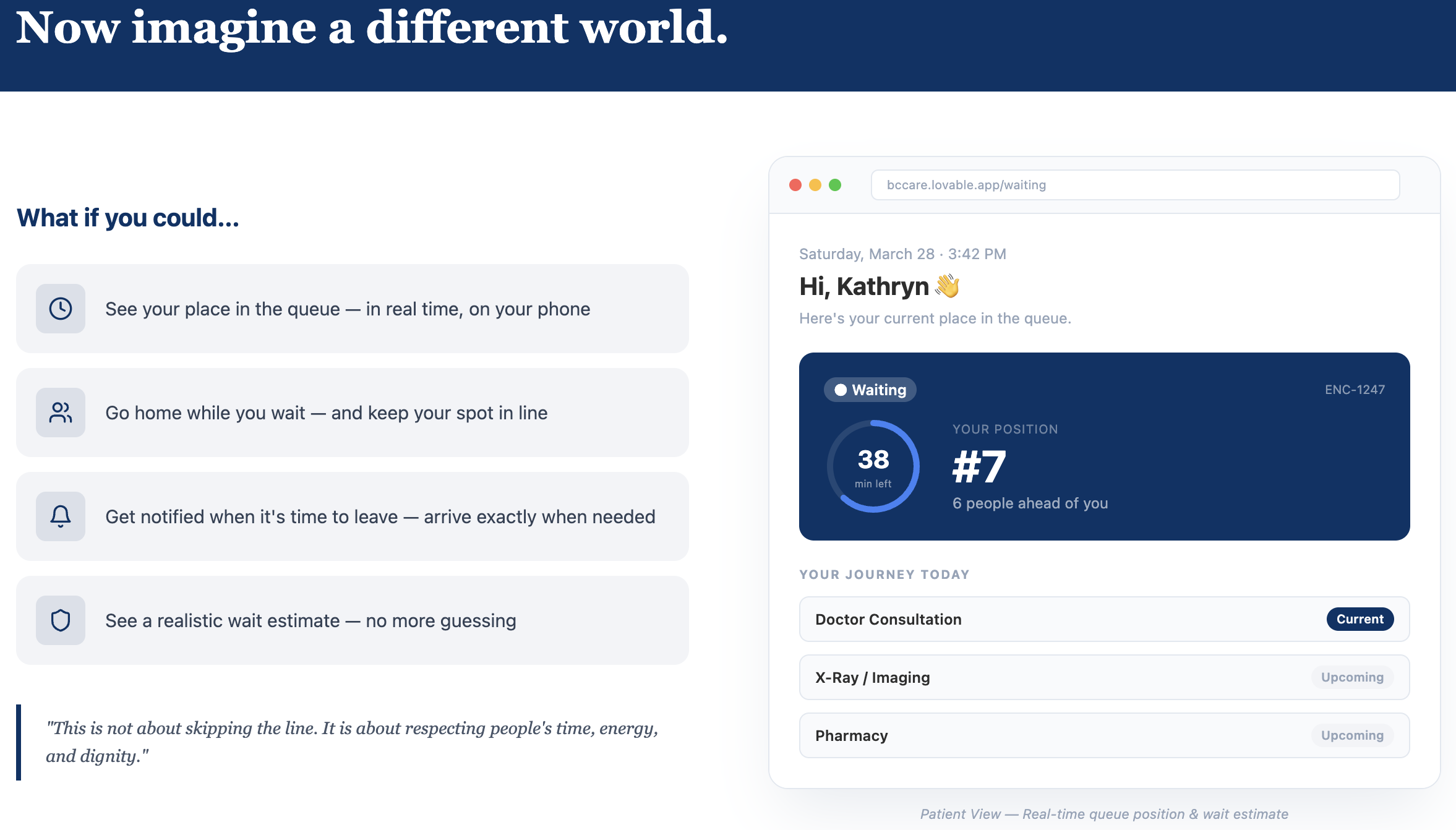
This is not about skipping the line. It is about respecting people's time, energy, and dignity while still working within the realities of emergency care.
What We Built
Queue Smart is a dual-layer platform built around two connected but distinct experiences. Two people with subject matter knowledge and extensive technical capabilities built it in six hours at a hackathon.
The Patient Communication Layer
The patient-facing side reduces uncertainty during the care journey. Patients see their current queue position, an estimated wait time range, and their next step in care. They receive notifications on their phone. The system provides plain-language explanations without false precision or unnecessary clinical detail. Most importantly, it supports a go-home-and-wait model: patients can leave the physical waiting room, continue with their day, and return when notified.
Research supports this approach. A study from the University of North Carolina found that virtual urgent care visits had a median turnaround time of 9 minutes compared to 49 minutes for in-person visits, with 92% of patients rating their experience as good or better . Queue Smart applies the same principle to the physical ER: reduce unnecessary time in the building without reducing quality of care.
The Clinical Side
On the clinician-facing side, staff see a live queue showing basic information about each patient: admittance time, assigned triage level, position in the queue, and whether the patient is currently in the ER or away. The queue order is automated based on arrival time and triage level, while also providing the ability to manually change a patient's triage level to reflect the realities of on-the-ground healthcare where situations can change quickly.
This matters because emergency department physicians spend over half of their shift on non-clinical activities. Nursing staff dedicate up to 75% of their shift to non-clinical work . Queue Smart does not fix that problem, but it gives clinicians a clear, real-time picture of who is waiting, how long they have been waiting, and who needs attention first.
The Technology Stack
We built Queue Smart on Microsoft Power Platform with Dataverse as the data foundation. Power Platform is a secure, governed, and compliant platform that meets the data handling requirements healthcare demands, and it is already used across healthcare organisations. The healthcare data model in Dataverse is based on the HL7 FHIR (Fast Healthcare Interoperability Resources) standard, providing a FHIR-aligned relational data model that ensures compatibility across data-centric solutions and aligns with familiar healthcare interoperability standards . Power Apps handles the application layer, Power Automate manages workflow and notifications, and Figma provided the design prototyping environment.
This stack was deliberate. Microsoft Power Platform supports rapid application development with low-code and no-code tools, which meant a team of two could build a working prototype in a matter of hours. But it also scales. The same FHIR-aligned data model, the same governance and compliance controls, and the same security posture carry forward into production. The platform supports enterprise integration with systems like Azure Health Data Services, virtual health data tables, and the FHIRlink connector for direct connectivity with clinical systems .
Why This Matters
Emergency department overcrowding is not a staffing problem or a funding problem in isolation. It is a system problem. Patients who do not need to be physically present in the waiting room are occupying space, consuming attention, and adding to the stress of an already strained environment. Giving those patients a way to wait on their own terms, with real-time information and reliable notifications, is a small change with outsized impact.
The evidence from virtual care programs across Canada confirms the direction. Ontario's virtual urgent care pilot across 14 emergency department sites found that 90% of patients reported high satisfaction, and 41% of virtual visits were managed entirely at home without an in-person follow-up . Queue Smart extends this logic to the patients who do need to visit the ER in person: keep them informed, give them their time back, and let the clinical team focus on clinical work.
Queue Smart was built in a single sitting by two people, on a platform that healthcare teams already trust and use every day. The problem it addresses is not a hackathon problem. It is an everyday reality for millions of Canadians. The technology exists. The data standards exist. The platform exists. What matters now is building the will to deploy it.
If your organisation is exploring how Microsoft Power Platform and applied intelligence can solve real operational problems, we would like to hear from you. Get in touch to talk about what is possible.
Frequently Asked Questions
Queue Smart is an emergency room patient communication platform built on Microsoft Power Platform during a healthcare hackathon. It shows patients their real-time queue position and an estimated wait time, and it lets them leave the waiting room while keeping their place in line. Clinicians get a live queue view with triage levels and patient context, and they can adjust priority as conditions change.
Yes. Queue Smart supports a go-home-and-wait model. Once triaged, a patient can opt in on their phone, leave the building, and carry on with their day. The system holds their place, updates in real time, and sends a notification telling them when to head back so they arrive on time and keep their spot. It is about respecting people's time and dignity, not skipping the line.
It runs on Microsoft Power Platform with Dataverse as the data foundation, built on a healthcare data model designed for clinical solutions. Power Apps handles the application layer, Power Automate manages workflow and notifications, and Figma was used for design prototyping. The same foundation scales to production, with enterprise integration into clinical systems through Azure Health Data Services.
Yes. Microsoft Power Platform is a secure, governed, and compliant platform that meets the data handling requirements healthcare demands, and it is already used across healthcare organisations. Its healthcare data model aligns with familiar healthcare interoperability standards, so solutions built on it stay compatible as they move from prototype to production.
Two people with subject matter knowledge and strong technical skills built a working prototype in six hours at a hackathon. That speed comes from Microsoft Power Platform's low-code and no-code tools, but the same governance, security, and data model carry forward into a production build. If your organisation wants to see what Microsoft Power Platform can do against a real operational problem, get in touch through the contact page.
Related Service
Process automation, RPA, and intelligent chatbots that handle the busywork.
Learn about Automation